+86-512-52396378
sales@szuniking.com
sales@szuniking.com
1 Longteng Rd, Tonggang Industrial Park, Changshu ETDZ, Jiangsu Province, China 215511
Views: 0 Author: Site Editor Publish Time: 2026-10-09 Origin: Site


The global push for zero-emission transportation is accelerating at an unprecedented pace. Yet, when evaluating heavy-duty applications, current battery technologies hit a severe physical and logistical wall. While battery electric systems excel in urban passenger transit, their massive weight and agonizing charging downtimes render them largely impractical for long-haul freight. Enter hydrogen fuel cells—a breakthrough technology fundamentally reshaping the commercial logistics landscape.
Today, hydrogen fueled vehicles are gaining massive traction among engineers, fleet operators, and automotive manufacturers. They offer the clean energy benefits of electric propulsion without the payload penalties of oversized battery packs. However, building these next-generation machines requires far more than just innovative fuel cell stacks. It demands advanced material solutions. Specialized engineering plastics are absolutely critical to ensure safety, durability, and efficiency under extreme operating conditions. This comprehensive guide explores the mechanics, market advantages, and rigorous material requirements that make hydrogen the ultimate game-changer for the transport sector.
Hydrogen fueled vehicles offer the most viable long-term zero-emission alternative for heavy-duty transport, consistently surpassing Battery Electric Vehicles in refueling speed and payload capacity.
The commercial viability of this technology relies heavily on lightweight, durable components manufactured from advanced polymer composites.
Thermal management and high-voltage safety in fuel cell systems are strictly dependent on the integration of specialized high-temperature polyamides and flame retardant plastics.
Industry data suggests the future of hydrogen transportation lies primarily in commercial trucks, trains, maritime vessels, and public transit fleets rather than passenger sedans.
To truly grasp why this technology is disrupting the transport sector, we must first establish a clear technical foundation of how these systems operate under real-world road conditions.
At the core of the vehicle lies the Proton Exchange Membrane fuel cell. Unlike traditional internal combustion engines that violently burn diesel, a fuel cell generates electricity silently through an elegant electrochemical reaction. Hydrogen gas sourced from the onboard storage tanks is fed directly into the anode. Meanwhile, ambient oxygen from the air enters the cathode. A specialized catalyst separates the hydrogen molecules into protons and electrons. Forced through an external circuit, these electrons generate the electrical current that drives the motor. Consequently, the only byproducts exiting the tailpipe are pure water vapor and heat, making it a genuinely zero-emission technology.
A functional hydrogen vehicle relies on a complex architecture of critical components working in perfect unison. The fuel cell stack acts as the heart of the system, while high-pressure cylinders—often pressurized to 350 or 700 bar—securely store the hydrogen gas. An electric motor translates the generated current into mechanical torque. This setup is supported by a smaller secondary battery pack designed to capture regenerative braking power and handle peak load demands. Specifically, these internal components operate under intense pressure and wildly varying temperature extremes. This harsh micro-environment sets a rigorous stage for the manufacturing materials required to build them safely.
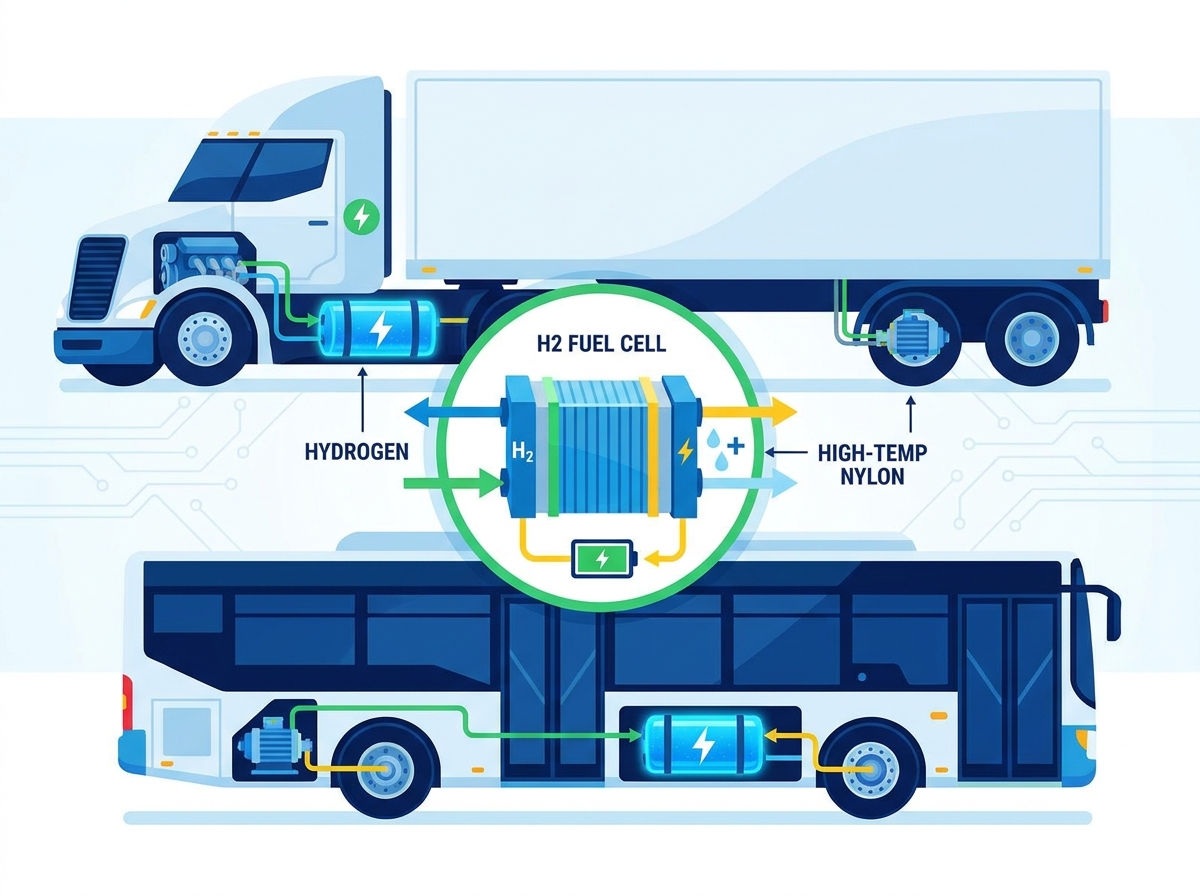
Recent market analyses reveal a definitive shift in the global hydrogen sector. The initial media hype surrounding passenger sedans has cooled significantly. Instead, capital is aggressively flowing into commercial trucking, maritime shipping, and rail networks. Analysts note that stringent emissions mandates, such as the upcoming Euro 7 standards, are forcing fleet operators to decarbonize rapidly. Because heavy-duty logistics cannot afford the downtime associated with megawatt battery charging, hydrogen is emerging as the only viable drop-in replacement for diesel.
Furthermore, the development of regional clean hydrogen hubs across North America and Europe is driving down the production cost per kilogram of fuel. Legacy truck manufacturers are forming strategic joint ventures specifically to scale up fuel cell production lines. This macroeconomic alignment signals that fuel cell technology has officially moved from the prototype phase into full-scale commercialization.
Empirical logistics studies increasingly point to hydrogen as the superior choice for long-haul applications. This contrasts sharply with the physical limitations of traditional electric trucks.
In the ruthless world of commercial trucking, weight directly dictates profitability. To achieve a 500-mile range, a heavy-duty electric truck requires a massive lithium-ion battery pack that can weigh several tons. This severe weight penalty must be subtracted from the truck's maximum allowable gross vehicle weight. It directly reduces the amount of freight the truck can legally transport. Hydrogen fueled vehicles elegantly circumvent this logistical nightmare. Because hydrogen gas is incredibly light and energy-dense, a complete fuel cell system weighs a fraction of an equivalent long-range battery pack. Fleet operators can maintain high payload capacities over cross-country routes without sacrificing their zero-emission compliance.
Operational downtime is another critical metric that can make or break a commercial fleet. Imagine a busy logistics hub where heavy-duty battery trucks are parked for several hours just to recharge. This bottleneck severely disrupts supply chains. In contrast, refueling a hydrogen truck mimics the familiar rhythm of pumping diesel. Pumping highly pressurized hydrogen gas into a commercial rig takes approximately 10 to 15 minutes. This rapid turnaround time is absolutely vital for highway trucks, freight trains, and maritime vessels where extended charging downtime is economically unfeasible.
Metric | Hydrogen Fuel Cells | Battery Electric Vehicles |
|---|---|---|
Refueling/Charging Time | 10 - 15 minutes | 2 - 6 hours |
Payload Impact | Minimal weight penalty, maximizes cargo | Heavy battery packs reduce legal payload |
Thermal Management | High continuous heat, requires advanced polymers | Moderate heat, standard cooling systems |
Ideal Application | Long-haul freight, maritime, rail | Urban transit, passenger cars, last-mile delivery |
Transitioning from theoretical advantages to physical manufacturing requires addressing the unique mechanical stresses of hydrogen power. Building these robust vehicles demands highly specialized material science.
Inside a functioning fuel cell, the environment is brutal. The core electrochemical reaction generates substantial and continuous heat. Standard commodity plastics will literally melt or deform inside a fuel cell stack. Automotive engineers must utilize high-temperature nylon compounds as the superior choice for thermal management. These advanced polymers boast a continuous operating temperature exceeding 150°C and offer peak thermal resistance up to 200°C. They are widely specified for critical fluid-handling components such as coolant manifolds, thermostat housings, and fuel cell end plates. By integrating these resilient materials, manufacturers ensure the system remains dimensionally stable and resists degradation from aggressive glycol-based coolants during grueling long-haul operations.
Handling highly pressurized hydrogen gas alongside 800-volt electrical architectures elevates safety to the absolute highest priority. To prevent thermal runaway and ensure strict compliance with automotive safety standards, the deployment of flame retardant engineering plastics is non-negotiable. These specialized materials achieve a strict UL94 V-0 fire rating at thicknesses as low as 0.8mm. Furthermore, they feature a high Comparative Tracking Index, which actively prevents electrical arcing. They are mandatory for crafting electrical housings, high-voltage connectors, and rugged battery enclosures. In the rare event of a collision or an electrical short, these formulated plastics actively self-extinguish and halt the spread of fire.
Achieving the perfect equilibrium of lightweighting and mechanical strength requires the deep integration of specific polymer composites throughout the vehicle's architecture.
In modern automotive engineering, metal replacement is a cornerstone strategy for improving overall efficiency. Every single kilogram saved by swapping out a heavy cast aluminum bracket with a high-performance polymer directly translates into improved fuel economy. However, these replacement parts cannot be fragile. They must endure the exact same mechanical loads, road vibrations, and impacts as their metal counterparts.
To achieve this uncompromising structural integrity, manufacturers rely heavily on glass fiber reinforced PA66. By embedding 30 percent to 50 percent microscopic glass fibers into the polyamide matrix, the resulting composite delivers exceptional tensile strength exceeding 180 MPa. It provides outstanding stiffness, dimensional stability, and chemical resistance. This makes it the ideal polymer for manufacturing hydrogen storage tank brackets, heavy-duty structural engine mounts, and rugged under-the-hood components. It effortlessly resists fatigue from continuous engine and road vibration, ensuring the vehicle sheds unnecessary weight without compromising commercial durability.
Despite its immense potential, the transition to a hydrogen-based transport ecosystem faces objective engineering and logistical hurdles that must be systematically addressed.
One of the most persistent historical challenges of this technology is hydrogen embrittlement. This is a destructive phenomenon where hydrogen molecules permeate traditional metals, causing them to become brittle and eventually fracture under stress. Utilizing the right polymer solutions actively prevents this premature component failure. High-performance engineering plastics completely bypass hydrogen embrittlement. By replacing vulnerable metal valves and distribution pipes with specialized polymers, manufacturers drastically improve component longevity and reduce fleet maintenance costs.
A revolutionary vehicle is only as useful as its refueling network. Historically, the glaring lack of hydrogen stations has bottlenecked widespread adoption. However, global infrastructure is currently expanding at an accelerated pace along major commercial freight corridors. The energy sector is also aggressively shifting toward green hydrogen—fuel produced via renewable energy electrolysis. This vital transition ensures that the entire lifecycle of the fuel remains genuinely zero-emission from production to tailpipe.
For procurement teams and design engineers, selecting the correct polymer is the difference between a system that runs for a million miles and one that fails in the field. Here is a practical engineering checklist:
Cooling and Fluid Dynamics: Specify high-temperature nylon compounds for thermostat housings and coolant manifolds to withstand 150°C continuous heat and resist glycol corrosion.
High-Voltage Electrical Systems: Utilize halogen-free flame retardant PA6 for connectors and battery housings to guarantee UL94 V-0 compliance and prevent electrical arcing.
Structural Mounts and Brackets: Deploy glass fiber reinforced PA66 with 30 to 50 percent fiber loading to replace cast aluminum, achieving high tensile strength and superior fatigue resistance.
Hydrogen fueled vehicles are no longer just a futuristic concept. They are a present-day reality actively revolutionizing heavy-duty transport. This monumental shift, however, relies entirely on a robust and innovative advanced material supply chain. The integration of high-temperature nylon compounds ensures critical system safety and thermal performance. Flame retardant plastics actively prevent dangerous electrical hazards, while glass fiber reinforced PA66 provides the essential structural strength needed to replace heavy metals. As the industry accelerates, automotive engineers and manufacturers must prioritize sourcing the highest quality engineering plastics. Visit Unikingtech today to explore our comprehensive portfolio of high-performance polymers, and consult with our material science experts to build safer, lighter, and more efficient fuel cells for the next generation of zero-emission transport.
Yes. They undergo incredibly rigorous crash and pressure testing before ever hitting the road. Furthermore, they utilize highly specialized materials to ensure maximum safety. Advanced polymers prevent electrical or thermal hazards and are formulated to self-extinguish, effectively mitigating fire risks even under extreme collision conditions.
They offer significantly faster refueling times, typically taking 10 to 15 minutes compared to the several hours required for mega-watt battery charging. More importantly, they do not require massive, multi-ton battery packs. This crucial weight advantage allows commercial trucks to carry significantly more freight over longer distances without sacrificing their legal payload capacity.
Operating fuel cells generate significant, continuous heat and function in chemically harsh environments. High-temperature polyamides maintain their structural integrity and resist thermal degradation far better than standard commodity plastics. They provide excellent thermal management for critical cooling components, ensuring long-term system reliability and preventing catastrophic coolant leaks.
These reinforced composites offer an incredible strength-to-weight ratio. They allow automotive manufacturers to confidently replace heavy metal brackets and mounts with lightweight polymer alternatives. This strategic metal replacement directly improves the vehicle's overall driving range and fuel efficiency without compromising the rugged structural durability required for punishing heavy-duty applications.
Modern commercial fuel cell stacks are engineered for extreme durability, typically targeting a lifespan of 25,000 to 30,000 operating hours. This equates to roughly one million miles on the road. Achieving this longevity relies heavily on using premium engineering plastics that resist chemical degradation and mechanical fatigue over years of continuous highway use.
Hydrogen fuel cells perform exceptionally well in cold weather. Unlike lithium-ion batteries, which experience severe range degradation and sluggish charging speeds in sub-zero temperatures, fuel cells generate their own internal heat during operation. This self-heating mechanism allows hydrogen trucks to maintain consistent driving ranges and rapid refueling times regardless of freezing external conditions.