+86-512-52396378
sales@szuniking.com
sales@szuniking.com
1 Longteng Rd, Tonggang Industrial Park, Changshu ETDZ, Jiangsu Province, China 215511
Views: 0 Author: Site Editor Publish Time: 2026-10-22 Origin: Site


Acrylonitrile Butadiene Styrene, commonly known as ABS, serves as a fundamental pillar in modern manufacturing. From intricate consumer electronics and household appliances to durable automotive interiors, this amorphous thermoplastic is highly valued for its dimensional stability and ease of processing. However, meeting strict fire safety compliance is an undeniable reality for engineers working in these high-stakes industries.
Herein lies the core engineering dilemma: incorporating combustion inhibitors to meet rigorous safety ratings often degrades the material's inherent thermal resistance and mechanical strength. Standard formulations frequently become brittle or suffer from high-temperature deformation under load. Achieving functional equilibrium is possible, but it requires advanced compounding, precise alloying, and a strategic approach to additive selection. This guide explores how to navigate these trade-offs to optimize your material performance.
Precision is Mandatory: Reaching a UL 94 V-0 rating requires specific additives, but improper dosing leads to a significant loss in impact strength and heat deflection temperature.
Regulatory Shifts Drive Innovation: Modern, eco-friendly systems are rapidly replacing legacy brominated options, demanding more sophisticated compounding to maintain performance.
Polymer Blends Offer Superior Limits: Utilizing a specialized flame retardant PC/ABS alloy often provides the best balance when pure resins fail to meet simultaneous heat and impact requirements.
Application Dictates Material Choice: Deep knowledge of the end-use environment is crucial. For extreme conditions, semi-crystalline alternatives like PA6 or PA66 often prove more effective than standard styrenics.
ABS relies on a continuous, uninterrupted structure of polymer chains and rubbery butadiene domains to dissipate impact energy. However, standard base resins are naturally flammable. To achieve the necessary fire resistance, compounding experts must introduce various agents, whether as powders, liquids, or concentrated masterbatches.
When these additives are dispersed, they physically disrupt the continuous polymer matrix. Large volumes of these agents act as microscopic stress concentrators. Imagine a heavy housing unit being dropped on a hard surface; instead of the polymer chains stretching to distribute the stress evenly, these disruption points trigger microscopic voids. This leads to premature fracturing, explaining why unmodified fire-resistant formulations often feel more brittle than their general-purpose counterparts.
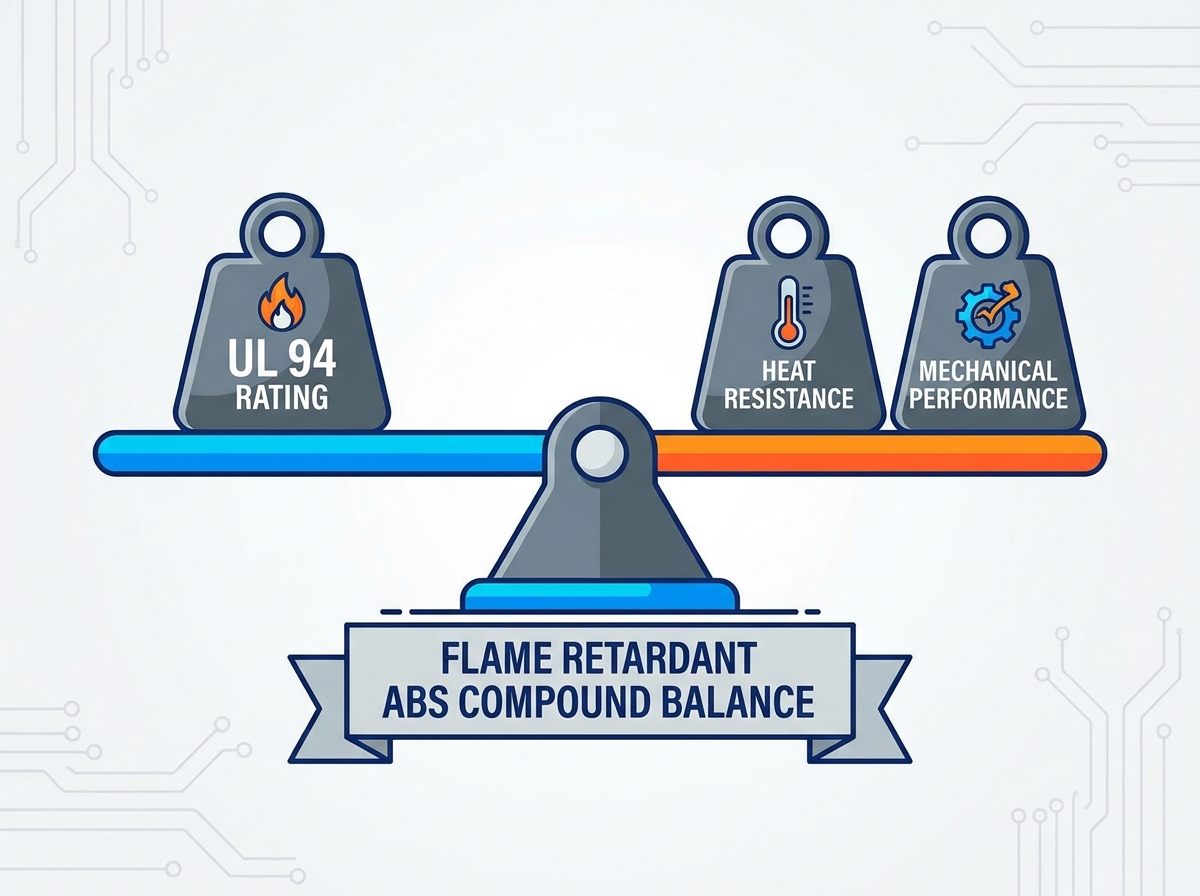
This reality forces engineers to navigate the "Iron Triangle" of compounding—the delicate tension between fire retardancy, thermal stability (HDT), and physical toughness. Improving one property almost inevitably pressures the others. Successfully overcoming these trade-offs demands advanced formulation technology and strictly optimized extrusion processes.
To select the right material, product designers must first understand the Underwriters Laboratories (UL) 94 standard, the global benchmark for plastic flammability. The testing protocol measures how a material burns and whether it produces flaming drips that could propagate fire.
HB (Horizontal Burn): The baseline rating, indicating slow burning but lacking reliable self-extinguishing properties.
V-2 (Vertical Burn): Burning stops within 30 seconds, though flaming drips are permitted.
V-1 (Vertical Burn): Burning stops within 30 seconds with no flaming drips allowed.
V-0 (Vertical Burn): The gold standard. Burning must cease within 10 seconds, and zero flaming drips are allowed.
For high-risk environments such as electric vehicle battery housings or sensitive electronics, UL 94 V-0 is the standard. However, designers must remember that flame retardancy is not an absolute material property; it is highly dependent on part geometry. A formulation that performs perfectly at a 3.0mm thickness may fail when injected into a thin-walled, 1.2mm component. Consequently, designing for thinner walls often necessitates higher additive concentrations, which further complicates the balance of mechanical integrity.
The Heat Deflection Temperature (HDT) indicates the point at which a polymer begins to warp under load. Conventional flame retardants, particularly low-molecular-weight halogenated options, often act as plasticizers. These molecules wedge themselves between long polymer chains, increasing the internal "free volume." This allows chains to slide past each other more easily, lowering the temperature at which structural deformation occurs.
To counteract this, industry leaders utilize advanced structural modifiers. Blending the base matrix with rigid copolymers such as Styrene Maleic Anhydride or specialized maleimides can effectively restrict chain mobility. This raises the overall thermal stability without sacrificing the flame inhibition mechanism. Furthermore, successful manufacturing relies on strict shop-floor discipline; overheating the material in the injection barrel can trigger premature thermal degradation, leading to off-gassing and catastrophic losses in both safety and physical performance.
The most noticeable side effect of using traditional synergists like antimony trioxide is the drop in Izod impact strength. Since these rigid particles do not chemically bond with the host resin, they act as defect sites. When a part is struck, these sites become initiation points for crack propagation.
Industry-wide efforts are now focusing on the integration of high-performance toughening agents to restore ductility. Using elastomers or specialized impact modifiers helps absorb energy before it can fracture the matrix. The key lies in precise dosage. Over-saturating a flame retardant ABS compound with rubbery components can degrade flowability and rigidity, requiring a fine-tuned, balanced formulation that respects the interplay between toughness and fire safety.
The global plastics market is undergoing a structural transformation. Driven by the rapid expansion of the electric vehicle sector and stringent environmental directives like REACH and RoHS, manufacturers are moving away from legacy brominated systems. Recent industry analysis confirms that the demand for high-performance, halogen-free flame retardant compounds is growing at a rate that traditional additives simply cannot match.
Unlike halogenated systems that inhibit flames in the gas phase, modern phosphorus and nitrogen-based intumescent systems operate in the condensed phase. When exposed to heat, they trigger a chemical reaction that forms a thick, insulating carbonaceous char. This layer effectively chokes off the oxygen supply to the underlying material, offering superior smoke toxicity profiles and improved stability. This shift is not just a regulatory mandate; it is a critical step in producing sustainable, high-safety components for the next generation of consumer electronics and automotive interiors.
There are physical limits to what pure ABS can handle, especially when dealing with ultra-thin wall sections. For high-demand applications, alloying with polycarbonate becomes the logical path. Polycarbonate provides a higher glass transition temperature and superior toughness, while the ABS component maintains processability and reduces internal molded stresses.
Adopting a specialized alloy creates a synergistic effect that solves the most stubborn engineering hurdles. These materials exhibit exceptional thermal stability and, when formulated with modern non-halogenated inhibitors, maintain strict compliance with safety regulations. For components that require long-term structural reliability under heat, this hybrid approach is often the most cost-effective and robust solution.
Successful material selection requires aligning the technical profile with the end-use environment. Avoid the mistake of using a "universal" grade for every application, as this either leads to unnecessary costs or product failure. Consider these selection criteria:
Consumer Electronics: Priority is given to high flow rates for complex geometries and halogen-free compliance to meet global environmental standards.
Automotive Interiors: Focus on low VOC emissions and high heat resistance to withstand extreme summer temperatures inside vehicle cabins.
Industrial Housings: Where chemical resistance and durability are paramount, semi-crystalline materials like PA6 are often better candidates than standard amorphous styrenics.
Navigating the supply chain for these specialized materials requires a collaborative approach. By working with custom compounding experts, you can align specific gate designs and molding parameters with a tailored resin formulation, ensuring that your parts meet both regulatory hurdles and performance targets on the production floor.
Balancing fire safety with thermal and mechanical performance is an engineering challenge, but it is entirely manageable with the right strategy. By leveraging the benefits of advanced alloying, halogen-free additives, and a clear understanding of your end-use demands, you can bridge the gap between safety and functionality.
Whether you need a high-flow material for intricate electronics or a robust alloy for demanding mechanical environments, professional technical support is your greatest asset. Contact our team today to discuss your requirements and let our experts assist you in selecting the ideal material for your next project.
The UL 94 vertical burn test evaluates how a material reacts to an ignition source. A V-0 rating indicates the highest level of safety, where burning stops within 10 seconds and no flaming drips are produced. A V-2 rating is more lenient, allowing for burning up to 30 seconds and permitting flaming drips that may ignite a cotton indicator beneath the specimen. V-0 is generally the requirement for safety-critical electronic components.
Historically, halogen-free formulations carried a premium price tag due to more complex additive chemistry. However, as economies of scale improve and environmental regulations tighten, the price difference has narrowed significantly. Today, they are considered standard for many high-growth industries, offering value through improved eco-compliance and lower smoke toxicity, which mitigates long-term regulatory and liability risks.