+86-512-52396378
sales@szuniking.com
sales@szuniking.com
1 Longteng Rd, Tonggang Industrial Park, Changshu ETDZ, Jiangsu Province, China 215511
Views: 0 Author: Site Editor Publish Time: 2026-09-26 Origin: Site


Transitioning from prototyping to production using glass-filled polymers introduces high stakes. Material failure or unpredicted warpage can ruin expensive tooling overnight. You need absolute certainty before authorizing mold fabrication or high-volume printing. A standard Technical Data Sheet (TDS) provides baseline laboratory data. However, evaluating a composite material requires translating those perfect numbers into real-world manufacturing realities. It takes deep engineering insight to read between the lines of a spec sheet. You must anticipate how reinforcing fibers behave under shear stress and thermal loads. This guide breaks down exactly how to scrutinize glass fiber reinforced nylon technical documents. We will compare critical polymer alternatives side-by-side. You will also learn how to qualify your manufacturing partners thoroughly before giving your final sign-off.
Evaluating a Technical Data Sheet requires immediate attention to moisture states. Nylon absorbs ambient humidity naturally. This absorption alters internal polymer chain mobility. You will always see two sets of numbers on a comprehensive TDS. One column shows Dry As Molded (DAM) properties. The other shows conditioned properties, usually tested at 50% Relative Humidity. You cannot rely solely on DAM figures. Parts operating in normal outdoor environments will inevitably reach a conditioned state. Moisture acts as a plasticizer. It lowers tensile strength while simultaneously increasing impact resistance. You must base your final engineering calculations on the conditioned data to avoid field failures.
Top-line tensile numbers only tell a fraction of the story. You must verify the stress-strain curves at your specific operating temperatures. Room temperature baselines look impressive on paper. However, polymer behaviors change drastically as they approach their glass transition phase. High heat environments weaken the polymer matrix gripping the glass fibers. When you review glass fiber reinforced nylon specifications, request extended thermal curves. A part enduring continuous stress at 120°C requires different baseline assumptions than a part sitting in a climate-controlled room. Evaluate the tensile modulus specifically under your anticipated peak thermal loads.
Heat Deflection Temperature (HDT) dictates dimensional stability under physical loads. Verify the exact load rating applied during the HDT test. Engineers typically test at either 0.45 MPa or 1.8 MPa. Glass-filled composites should demonstrate massive HDT gains over their unfilled counterparts. A standard nylon might deflect at 70°C under heavy loads. Adding 30% glass fiber often pushes this threshold well past 200°C. Additionally, ensure the specification sheet aligns with necessary regulatory requirements. Look for UL94 flammability ratings if designing electronics housings. Check for specific FDA compliance certifications if your product touches food or medical environments.
Standard nylon offers excellent toughness and low friction. Yet, it fails under specific extreme conditions. You must define the precise load-bearing thresholds where unfilled variants compromise your design. Continuous stress often induces severe material creep in standard nylon. Under-hood automotive components face extreme thermal cycling and chemical spray. A standard polymer matrix will soften, warp, or permanently deform in these scenarios. You reach a tipping point when structural rigidity outweighs the need for natural impact elongation. This transition dictates a shift toward fiber-reinforced composites.
Adding glass fibers fundamentally alters material behavior. You gain incredible structural advantages while sacrificing specific aesthetic and physical flexibilities. These trade-offs require careful engineering consideration.
Consider these critical material behavior shifts:
Table: Performance Shifts Between Unfilled and Glass-Filled Nylon
| Property Category | Standard Unfilled Nylon | 30% Glass-Filled Nylon |
|---|---|---|
| Tensile Strength | Moderate (Highly ductile) | Exceptionally High (Rigid) |
| Impact Resistance (Izod) | High (Absorbs shock well) | Low (Prone to brittle fracture) |
| Heat Deflection (1.8 MPa) | Typically 60°C - 80°C | Often exceeds 210°C |
| Surface Aesthetics | Smooth, glossy finish | Matte, textured, visible fibers |
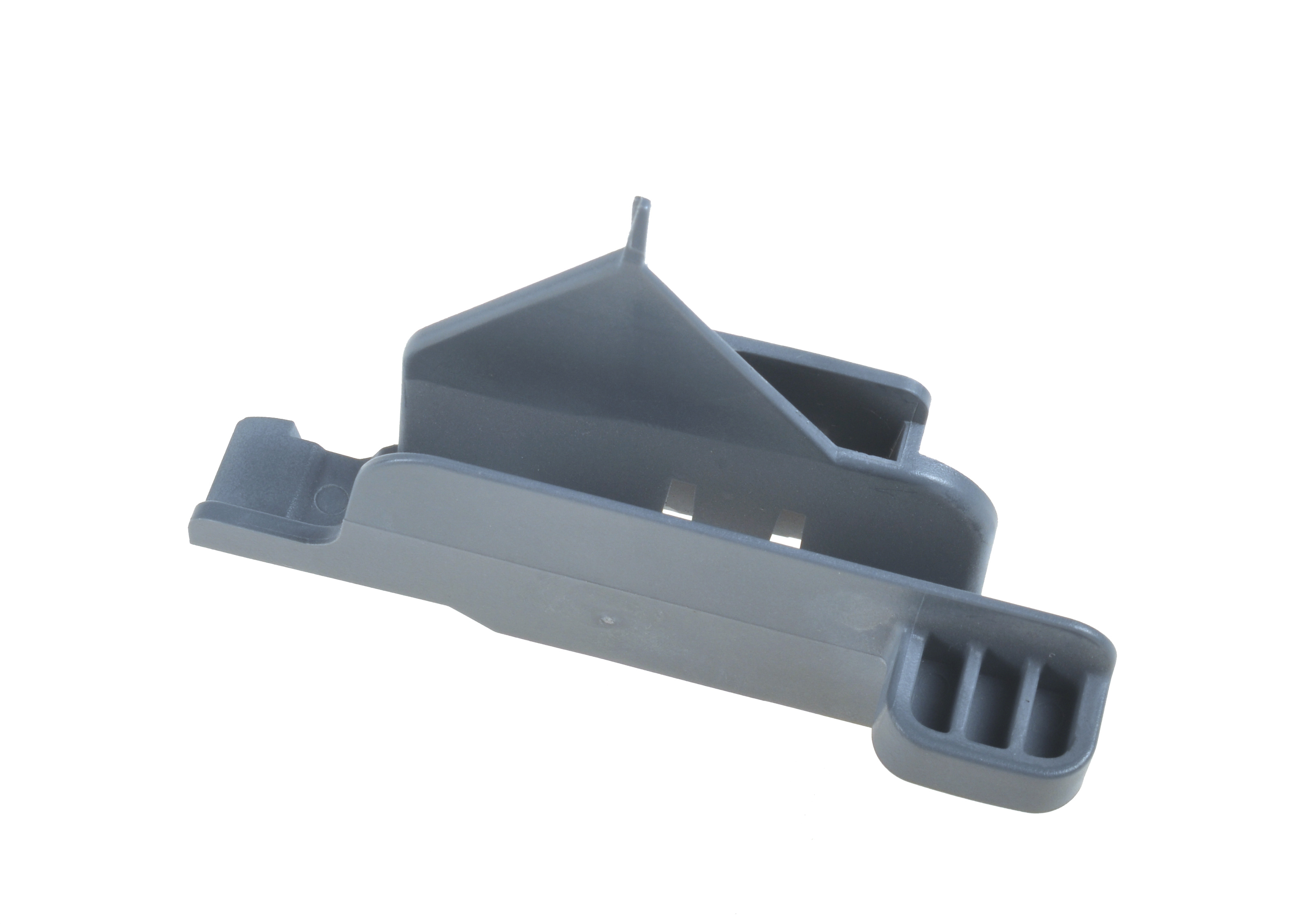
Engineers often default to nylon for extreme heat and chemical resistance. Nylon survives exposure to oils, greases, and aliphatic hydrocarbons effortlessly. However, its hygroscopic nature presents severe challenges in wet environments. Water absorption alters dimensions and degrades electrical insulation properties. You need an alternative if your part operates submerged or in high humidity. Evaluating a 25 glass fiber reinforced pom provides a highly stable substitute. Polyoxymethylene (POM or Acetal) repels moisture effectively. It maintains tight dimensional tolerances regardless of ambient humidity. Furthermore, POM offers naturally lower friction coefficients, making it superior for moving gears and sliding mechanisms.
Selecting the right composite requires a structured filtering approach. Do not rely on tensile strength alone. Build a comprehensive decision matrix before locking in a resin. When you use databases to find by material, prioritize environmental realities over peak laboratory data. Continuous use temperature remains the primary filtering criterion. Next, map out exact chemical exposures. Hydrocarbons favor nylon matrices, whereas highly acidic environments might degrade POM quickly. Finally, evaluate environmental moisture levels. A wet environment immediately disqualifies standard nylon for precision-tolerance parts. Weigh these three environmental factors before comparing mechanical strength.
Moving fiber-reinforced resins into mass production introduces harsh physical realities. Glass fibers act like microscopic abrasive cutting tools during the injection process. They tear through standard tooling rapidly.
Additive manufacturing handles composites differently than injection molding. 3D printing technologies like Selective Laser Sintering (SLS) or Multi Jet Fusion (MJF) rely on layer-by-layer adhesion. You must acknowledge a fundamental mechanical limitation here. Printed glass-filled parts exhibit drastically lower Z-axis tensile strength compared to their X and Y axes. The fibers do not cross the layer boundaries effectively. Furthermore, you must verify porosity limits. Sintered parts naturally contain microscopic voids. You must implement strict post-processing requirements. Sealing surface finishes through vapor smoothing or epoxy infiltration becomes mandatory for fluid-tight applications.
Inconsistent raw materials guarantee manufacturing failures. You must demand strict traceability protocols from your manufacturing partners. Request comprehensive lot-to-lot material consistency reports. The compounding process dictates fiber length and distribution. Variations in retained glass fiber length directly alter the final part strength. A batch processed with excessive shear will shatter the glass strands prematurely. This turns a high-strength composite into a weak, brittle substitute. You need documented proof showing consistent fiber lengths across multiple material batches before moving into production.
Raw material providers must offer deep engineering support. A reliable glass fiber reinforced nylon supplier acts as a technical partner, not just a vendor. They should provide accurate moldflow analysis data to help predict warpage and optimize gate locations. Furthermore, they must supply exact drying instructions. Processing wet nylon destroys the polymer chain. They must specify exact temperature and time limits for desiccant drying. Over-drying causes thermal degradation, while under-drying causes hydrolysis. They must also recommend precise processing parameters, including ideal barrel temperatures and back-pressure settings to minimize fiber breakage.
Filter potential partners using strict operational criteria. Verify their ISO certifications immediately to ensure baseline quality management standards. Next, investigate their Minimum Order Quantities (MOQs). Custom compounds featuring unique fiber percentages, specialized UV stabilizers, or specific color matches often require massive MOQs. Ensure their requirements fit your production scale. Finally, audit their raw material lead times. Supply chain disruptions affect specialty polymers heavily. Your chosen partner must demonstrate resilient sourcing capabilities and hold adequate buffer stock to protect your ongoing manufacturing schedule.
A: Nylon is highly hygroscopic. It absorbs ambient moisture quickly. Excess moisture present during the melting phase causes hydrolysis. This chemical reaction leads to severe molecular degradation. You will see noticeable splay marks on the part surface, accompanied by a catastrophic loss of mechanical properties. Proper desiccant drying prevents this structural breakdown.
A: No. Standard aluminum or P20 steel molds degrade rapidly. The high-pressure flow of glass fibers causes extreme abrasion, wearing away gate geometries and mold details. Hardened tool steel, such as H13 or better, is strictly required to survive the abrasive environment of production volumes.
A: Higher fiber percentages exponentially increase part stiffness and heat deflection resistance. However, they make the material increasingly brittle. High glass loads decrease melt flow significantly. This makes the material much harder to process, increasing the risk of internal voids, short shots, and poor cosmetic surface finishes.