+86-512-52396378
sales@szuniking.com
sales@szuniking.com
1 Longteng Rd, Tonggang Industrial Park, Changshu ETDZ, Jiangsu Province, China 215511
Views: 0 Author: Site Editor Publish Time: 2025-11-13 Origin: Site


Choosing the right engineering plastic can make or break a product’s performance, cost-efficiency, and reliability. Among all polyamides, nylon 6 pellets (PA6) are one of the most widely used materials thanks to their excellent balance of strength, toughness, and affordability. Yet, other nylon families—such as nylon 66 and nylon 12—also have their advantages. To help engineers, designers, and buyers make the best decision, Suzhou UNIKING New Material Co., Ltd. offers this detailed comparison guide covering specifications, performance characteristics, and practical recommendations for selecting the right nylon grade for your next project.
Before deciding which polyamide to use, it’s helpful to understand the physical and mechanical differences between the most common grades. The table below summarizes the core specifications.
Property | Nylon 6 (PA6) | Nylon 66 (PA66) | Nylon 12 (PA12) |
Tensile Strength | High | Very High | Moderate |
Melting Point | ~220°C | ~260°C | ~180°C |
Moisture Absorption | Moderate | Higher | Low |
Wear Resistance | Excellent | Excellent | Good |
Flexibility | Good | Fair | Excellent |
Cost | Lower | Medium | Higher |
Common Uses | Gears, bearings, connectors, casings | Engine covers, structural parts, fasteners | Tubing, cable protection, lightweight parts |
From this table, it’s clear that nylon 6 pellets strike a great balance between performance and cost. Nylon 66 provides slightly higher heat resistance, while nylon 12 excels in moisture resistance and flexibility but at a much higher price.
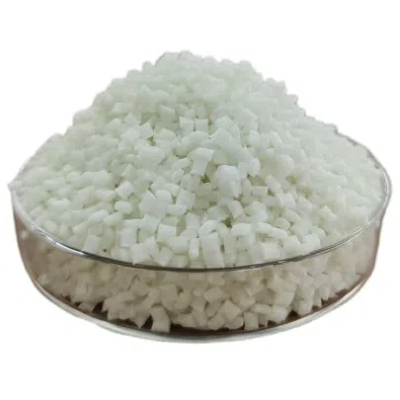
Nylon 6 pellets (also known as PA6 or PA 6 granules) are an excellent choice for engineers and manufacturers seeking a material that performs reliably across a wide range of mechanical and environmental conditions. This grade combines toughness, wear resistance, and impact strength in one cost-effective material, making it ideal for both high-volume and precision applications.
PA6 performs exceptionally well in situations involving friction, abrasion, or repeated impact. Its semi-crystalline molecular structure allows it to maintain surface hardness while providing sufficient flexibility to absorb shocks. That’s why it’s frequently used in gears, bushings, and bearings, where long-term wear resistance is critical.
Suzhou UNIKING New Material Co., Ltd. supplies nylon 6 granules that undergo optimized compounding processes to ensure excellent consistency and mechanical integrity, minimizing failure risks in demanding environments.
Compared with other nylons, PA6 offers a more favorable balance between performance and cost. It is easier to process, which reduces cycle times and energy consumption in injection molding or extrusion. This makes it a preferred choice for mass-produced components such as automotive clips, cable ties, and housings where manufacturers must control production costs without compromising on reliability.
Nylon 6 maintains its mechanical properties at elevated temperatures and resists many oils, greases, and cleaning agents. Its heat deflection temperature is sufficient for under-the-hood automotive applications, while its chemical stability ensures longevity in industrial settings. For instance, PA6 pellets are often used in electrical connectors and machinery parts that must withstand both mechanical load and thermal cycling.
One reason many engineers favor PA6 is its dimensional stability. Even with moderate moisture absorption, properly conditioned nylon 6 retains tight tolerances. Suzhou UNIKING’s formulation enhances crystallinity and moisture equilibrium, ensuring parts remain dimensionally accurate throughout their service life—a key factor in precision assemblies like valve components or instrument housings.
In summary, when your project demands strength, wear resistance, heat stability, and value for money, nylon 6 pellets remain the most versatile option.
While PA6 is highly versatile, there are certain cases where other nylon families may deliver better performance depending on the operating environment or design requirement.
If your component is continuously exposed to temperatures above 200°C, nylon 66 may be a better choice. It has a higher melting point and better resistance to thermal creep, making it suitable for engine covers, fuel line connectors, and high-temperature fasteners. However, the tradeoff is higher cost and slightly lower processability.
Nylon 6 tends to absorb more moisture than nylon 12. In humid environments or underwater applications, this could lead to dimensional changes or slight loss of stiffness. Nylon 12, with its long aliphatic chain, absorbs very little water—less than 1%. That makes it ideal for hydraulic hoses, tubing, and pneumatic parts where precision and stability are essential.
However, nylon 12 is more expensive and less rigid, so its use is typically reserved for specialized high-end or outdoor applications.
For flexible components that must endure repeated bending or vibration, nylon 12 offers superior flexibility and impact resistance even at low temperatures. By contrast, nylon 6 and nylon 66 are stiffer materials. For parts like cable sheaths, sports equipment, or lightweight protective casings, nylon 12’s resilience can justify its higher cost.
Ultimately, choosing between nylon 6, nylon 66, and nylon 12 involves balancing cost with the mechanical or environmental demands of the application. PA6 remains the go-to for general engineering needs, while PA66 and PA12 fill performance niches. Engineers should always assess part geometry, expected loads, and long-term exposure to temperature or humidity before finalizing their selection.
Suzhou UNIKING’s materials team can assist customers with side-by-side grade comparisons to ensure that every project achieves optimal cost-performance efficiency.
Switching to a new material, even within the same polymer family, always carries risk. Proper testing ensures that the chosen nylon grade performs as expected in the final product environment. Here are several practical steps to validate your design before committing to large-scale manufacturing.
Begin by producing small runs of molded parts using the intended nylon grade. Monitor melt flow, cooling rates, and surface quality to ensure the pellets behave consistently with your processing parameters. Suzhou UNIKING provides sample quantities of PA 6 granules for prototype testing, enabling engineers to optimize processing before scaling up.
Perform tensile, flexural, and impact tests on trial parts to measure the mechanical integrity of the molded components. Compare these results against design specifications. Check for warping, shrinkage, or surface irregularities that could indicate suboptimal moisture control or crystallization.
Simulate the working environment by exposing the parts to heat, humidity, or chemical agents. This helps determine how moisture absorption and temperature fluctuations affect long-term stability. Nylon 6, for example, may gain slight flexibility after conditioning but generally retains high wear resistance.
Before mass production, ensure all raw materials meet internal RS (Raw Specification) and QA (Quality Assurance) standards. Verify supplier certifications, batch consistency, and pellet uniformity. Suzhou UNIKING maintains strict production controls to guarantee that every lot of PA6 pellets delivers stable performance and consistent quality across applications.
By following these steps, manufacturers minimize costly rework and ensure the chosen material truly aligns with their product’s functional requirements.
Every engineering project is unique, and material selection must align with mechanical, environmental, and economic priorities. Nylon 6 pellets provide an outstanding combination of strength, thermal stability, and cost-effectiveness, making them the most balanced choice for general-purpose engineering plastics. For extreme conditions—whether higher heat tolerance or reduced moisture sensitivity—alternative nylons like PA66 or PA12 may be preferred, but typically at higher cost.
Suzhou UNIKING New Material Co., Ltd. offers a full range of PA materials, from PA 6 granules to specialized modified compounds, ensuring that customers can source the most suitable grade for their performance and budget requirements. Our commitment to innovative research, professional manufacturing, and technical support ensures that every customer receives not just materials—but complete solutions.
For detailed grade comparisons, material datasheets, or free sampling requests, please contact us today. Our technical experts will help you identify the right polymer formulation for your specific needs.
Contact us to learn more about our nylon engineering materials and how they can enhance your next project.