+86-512-52396378
sales@szuniking.com
sales@szuniking.com
1 Longteng Rd, Tonggang Industrial Park, Changshu ETDZ, Jiangsu Province, China 215511
Views: 0 Author: Site Editor Publish Time: 2026-07-05 Origin: Site


Automotive exterior door handles endure extreme mechanical stress, daily thermal cycling, and constant UV exposure. These critical touchpoints demand flawless functionality and aesthetic appeal over a vehicle's entire lifespan. While traditional zinc alloys and standard unreinforced plastics fail to balance weight reduction with structural integrity, highly filled polymers are rapidly becoming the industry standard.
This guide evaluates the viability of 50% glass fiber PA6 as a robust structural replacement for metal and lower-grade plastics. We focus heavily on performance outcomes, processing realities, and procurement considerations for Tier 1 and Tier 2 automotive suppliers. Readers will learn how this high-strength polymer exceeds OEM pull-force standards while driving significant weight savings. We will also uncover the precise manufacturing adjustments necessary to overcome injection molding challenges and achieve premium surface finishes.
Replacing heavy zinc alloys with 50% glass fiber nylon 6 reduces component weight by up to 40% while meeting strict OEM pull-force safety standards.
Utilizing a specialized weather resistant PA6 prevents the embrittlement and chalking typical of standard polyamides exposed to harsh exterior environments.
High glass loadings introduce injection molding challenges (e.g., floating fibers, mold wear) that require specific surface treatments and tooling modifications for class-A exterior finishes.
Evaluating specific grades, such as PA6 2150V, ensures manufacturers achieve the necessary balance of high melt flow and rapid crystallization required for cost-effective cycle times.
Designing modern door handles requires engineers to solve multiple physics problems simultaneously. Components must remain lightweight. They must survive decades of abuse. They must also protect passengers during emergencies. We evaluate these demands across three primary categories.
Crash Safety & Pull-Force Requirements: Door handles act as critical safety tethers. OEMs require handles to withstand severe emergency pull forces. This threshold often exceeds 1000 Newtons. During a side-impact collision, handles cannot shatter or detach. Emergency responders rely on structural integrity to wrench open jammed doors. Standard plastics simply shear under these sudden, high-velocity loads.
Environmental Extremes: Vehicles operate in punishing climates. Components must maintain dimensional stability across temperatures ranging from -40°C to +85°C. In freezing conditions, many polymers become critically brittle. Under intense desert heat, inferior plastics suffer from creep and deformation. Handles must resist both extremes without compromising internal latching mechanisms.
The Lightweighting Mandate: Automakers aggressively target weight reduction to extend EV battery range. Transitioning away from metal components is essential. However, consumers associate a "solid" tactile feel with vehicle quality. Engineers must replace heavy alloys without sacrificing acoustic resonance and haptic feedback. Hollow-feeling plastics degrade brand perception instantly.
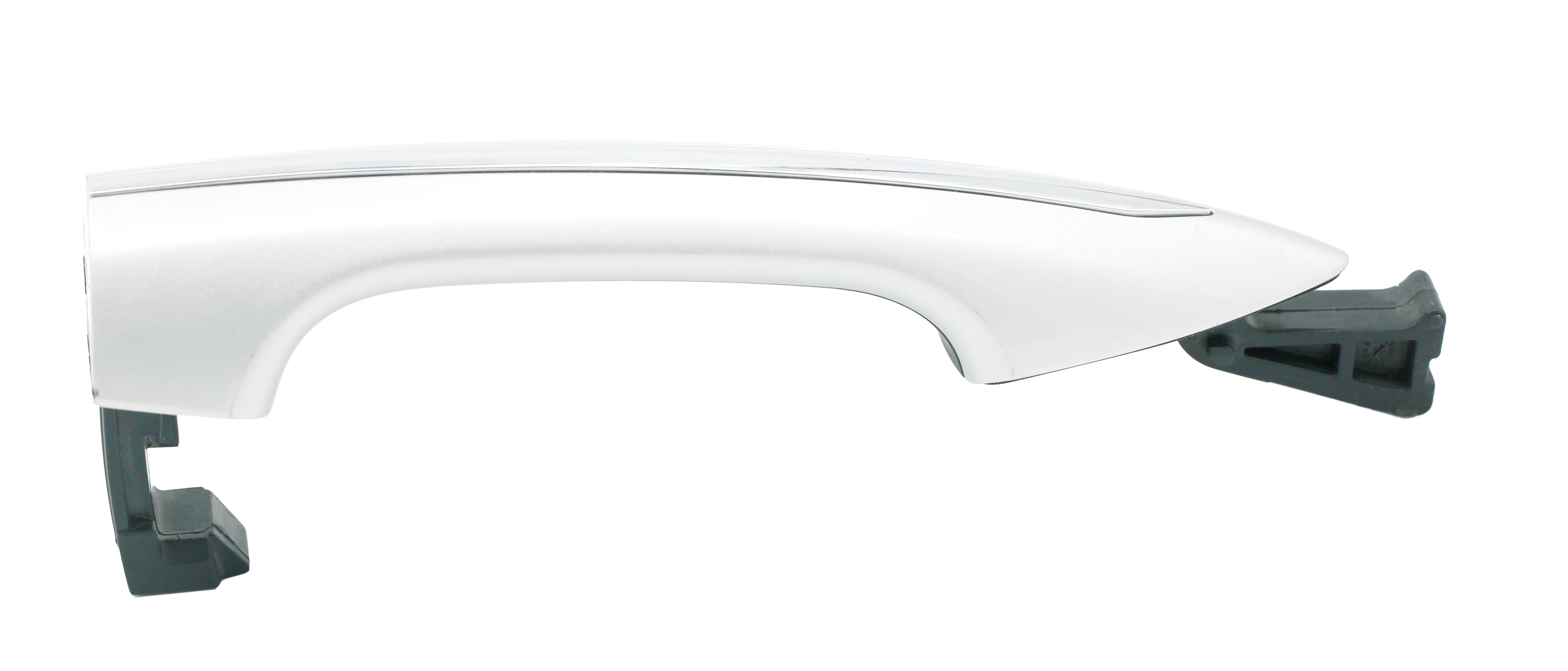
Adding high concentrations of glass fibers fundamentally alters base polyamide properties. A 50% loading transitions the material from a basic commodity plastic into a structural engineering grade. This transformation directly addresses the stringent demands of modern automotive exteriors.
The 50% glass reinforcement significantly increases the flexural modulus. This internal scaffold matches the stiffness required to prevent handle deformation under heavy loads. When users pull violently on a frozen handle, the polymer matrix transfers the stress along the glass fibers. This distribution prevents localized yielding. Flush-mounted electronic handles specifically benefit from this rigidity. They utilize longer cantilever designs that amplify bending forces.
Nylon naturally absorbs moisture from the atmosphere. Water acts as a plasticizer. It drops the tensile strength and alters part dimensions. However, high glass fiber content displaces the resin volume. This drastically reduces overall moisture absorption rates compared to unfilled PA6. The resulting composite prevents warping over time. It helps assembly plants maintain the extremely tight tolerance limits required for modern exterior gaps.
Sunlight destroys unprotected polymers through photo-oxidation. It breaks molecular chains and destroys impact toughness. When formulated properly as a weather resistant PA6, the material fights back. Compounding facilities embed specific UV stabilizers and carbon black into the matrix. These additives absorb and safely dissipate damaging ultraviolet radiation. This chemical defense preserves both aesthetic and structural integrity over a demanding 10-to-15-year vehicle lifespan.
Property Metric | Unfilled PA6 Base | 50% GF PA6 Performance | Impact on Door Handle Design |
|---|---|---|---|
Flexural Modulus | ~2,800 MPa | ~15,000+ MPa | Prevents bending during emergency high-force pulls. |
Shrinkage Rate | 1.5% - 2.0% | 0.2% - 0.5% | Ensures tight assembly tolerances for flush e-latch designs. |
Heat Deflection (HDT) | ~65°C | ~215°C | Prevents deformation under direct desert sun exposure. |
Specifying the correct automotive door handle material requires evaluating trade-offs. No single material perfectly satisfies every engineering variable. We must compare highly reinforced PA6 against established legacy materials to justify the transition.
PC/ABS remains a popular choice for interior trims and unpainted exterior components. It offers excellent dimensional stability right out of the mold.
Pros of PA6: PA6 offers vastly superior chemical resistance. Door handles face constant exposure to gasoline drops, mechanic greases, and aggressive car wash detergents. PA6 ignores these chemicals, whereas PC/ABS can suffer environmental stress cracking. PA6 also boasts significantly higher mechanical yield strength.
Cons of PA6: Processing PA6 requires tighter moisture control prior to molding. You must dry the pellets thoroughly to prevent splay marks. Furthermore, PC/ABS generally offers an easier path to a high-gloss, Class-A surface finish without extensive secondary processing.
Die-cast zinc alloys defined automotive door handles for decades. They provide undeniable heft and massive inherent strength.
Pros of PA6: Transitioning to plastics offers massive weight reduction. A single vehicle can shed several pounds. PA6 completely eliminates galvanic corrosion issues. Furthermore, it offers lower volumetric material costs. You mold the final shape faster and cheaper per cubic centimeter.
Cons of PA6: Replicating metal stiffness requires complex injection tooling. Designers must add intricate internal ribbing networks. Achieving the same perceived density and tactile stiffness as metal demands flawless structural engineering.
Standard 30% glass-filled nylon is ubiquitous in automotive under-hood applications. It balances strength with relative processing ease.
Pros of PA6 (50% GF): Moving to a 50% loading delivers the higher yield strength and absolute stiffness necessary for modern flush-mounted handles. These electronic door handle designs experience immense leverage forces. 30% GF often exhibits too much flex for these premium applications.
Cons of PA6 (50% GF): Higher glass content decreases ambient impact toughness. The material becomes more brittle if not properly conditioned with moisture after molding. Additionally, pumping 50% glass through an injection machine is significantly more abrasive on expensive mold tooling.
Material Type | Weight Advantage | Surface Finish Difficulty | Chemical Resistance | Ideal Application |
|---|---|---|---|---|
50% GF PA6 | High (Lightest) | High (Needs treatments) | Excellent | Structural flush handles, e-latches |
PC/ABS Blend | Medium | Low (Naturally glossy) | Moderate | Interior handles, low-stress covers |
Zinc Alloy (Zamak) | Negative (Heavy) | Medium (Needs plating) | Good (If plated) | Classic lever-style heavy handles |
30% GF PA6 | High | Medium | Excellent | Internal brackets, traditional pull handles |
Designing the part on a screen is only half the battle. Manufacturing high-glass polymers demands strict process discipline. Process engineers must anticipate aggressive material behaviors to yield acceptable aesthetic parts.
A 50% glass loading naturally pushes fibers toward the surface during the injection phase. The plastic resin cools faster than the glass. This thermal mismatch leaves microscopic glass strands exposed. This phenomenon ruins the visual aesthetic of any exterior trim plastic. Mitigation requires decisive molding strategies.
Best Practice: Elevate mold temperatures aggressively. Running molds at 90°C to 120°C slows the resin skin formation. It allows the polymer matrix to properly encapsulate the glass fibers. Combine this with optimized, massive gate designs and rapid injection speeds. Fast injection creates high shear heat, keeping the melt flow highly fluid at the flow front.
Injecting heavily reinforced compounds acts like sandblasting your mold interiors. Glass fiber nylon 6 is highly abrasive. Standard P20 tool steel will wash out and degrade rapidly. Dimensions will shift. Flash will develop around parting lines.
Common Mistake: Under-budgeting tool maintenance. Specifiers must account for the initial cost of fully hardened steel molds (like H13). You must also plan for frequent maintenance of high-wear areas. Replaceable gate inserts and runner blocks are mandatory design inclusions to control long-term production costs.
Most exterior handles receive body-color paint or specialized hydro-dipped coatings (such as carbon-fiber-look trims). Polyamides naturally possess low surface energy. Paint does not want to stick to them natively. High glass content exacerbates this problem.
Surface energy must be managed mechanically or chemically. Pre-treatments are often required to ensure paint adhesion on highly reinforced PA6 substrates. Engineers frequently specify inline plasma or flame treatment stations. These processes temporarily oxidize the plastic surface. They create microscopic bonding sites that allow primers and topcoats to anchor permanently, passing aggressive cross-hatch adhesion testing.
Procuring raw material for safety-critical components leaves no room for ambiguity. Tier 1 suppliers must rigorously vet material compounds before cutting steel for molds. Follow these non-negotiable procurement steps.
Validate Material Data Sheets (MDS): Do not accept generic "50% GF PA6" specifications. The market floods with recycled or heavily modified wide-spec materials. Demand exact, verified data. Look specifically for notched Izod impact strength values at both room temperature and -30°C. Require precise heat deflection temperature (HDT) metrics. Most importantly, demand certified UV aging test results matching automotive standards (e.g., SAE J2527).
Assess Grade Consistency: Specify established automotive grades like PA6 2150V to guarantee lot-to-lot consistency. Variance in glass fiber dispersion destroys structural reliability. Fluctuations in the melt flow index (MFI) will force your machine operators to constantly adjust injection profiles. Consistent MFI guarantees repeatable cycle times and limits scrap rates.
Evaluate Supplier Technical Support: Purchasing resin is only part of the transaction. You need engineering partnerships. Choose compounding partners capable of providing comprehensive moldflow analysis. They should supply detailed processing guidelines and troubleshooting matrices. This specific technical support helps your injection molding team minimize initial defect rates during the critical launch phase.
Transitioning to advanced polymers represents a necessary evolution in automotive exterior design. The final verdict is clear: 50% glass fiber PA6 serves as a highly capable, structurally superior material for automotive exterior door handles. It delivers the massive rigidity required for modern flush-mounted handles while slashing vehicle weight. However, success requires acknowledging and actively managing the associated tooling wear and surface finish challenges during the initial design phase.
To successfully integrate this material into your next vehicle program, follow these actionable next steps:
Request sample pellets immediately to conduct localized plaque testing for tensile validation.
Run extensive moldflow simulations based on your specific handle geometry to predict fiber orientation and weld lines.
Collaborate early with your designated coating supplier to verify paintability and finalize surface pretreatment requirements.
Upgrade your tooling specifications to require hardened steel inserts at all high-velocity injection gates.
A: Modern flush door handles and electronic latch mechanisms require higher stiffness and lower creep under load, making the 50% reinforcement necessary despite the added processing difficulty.
A: Yes, but it requires highly optimized injection molding parameters (high mold heating, rapid injection) and typically a primer/paint process or advanced surface treatments to cover glass fiber flow marks.
A: It incorporates specialized UV absorbers and hindered amine light stabilizers (HALS) during compounding, which neutralize the free radicals generated by sunlight, preventing the plastic from turning chalky or brittle.
A: While structurally viable, replacing metal requires a complete redesign of the component's internal ribbing and mounting points to account for the distinct shrinkage and stress distribution properties of high-GF plastics.